Some tack photos

I have stored an excessive amount of photos on my laptop and am doing a spring clean. I have come across these two possibly worth posting as regards tack and equipment:

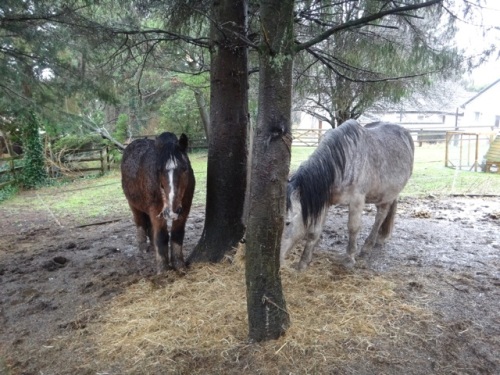
Ben enjoying his Micklem bridle on the second bitless setting – where the reins are attached to a leather curb strap:

IMG_1736.jpg

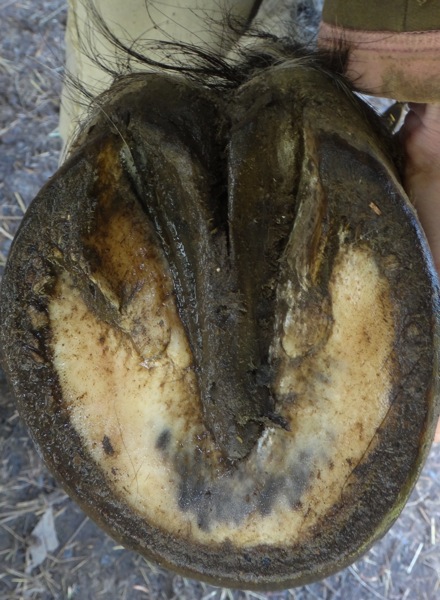
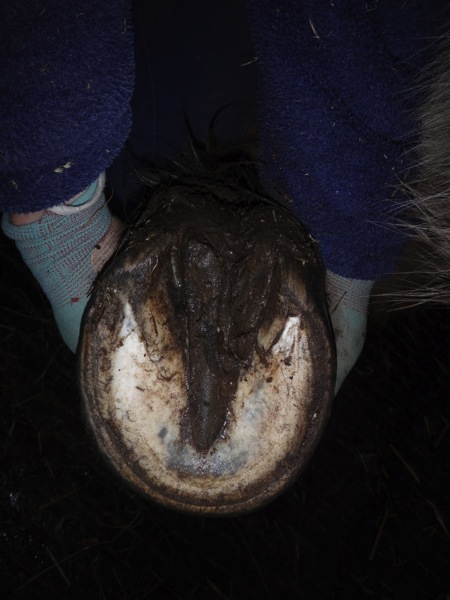
The Trail hoof boots failing at the first serious test – we rode into a stream and then up a small bank:

IMG_2049.jpg

1 Comment

Filed under tack

Clicker training weekend revisited

I was going through old photos on the laptop and came across a series of photos taken on the third day of the clicker training clinic I attended last year. This was the day where it all seemed to come together for me and Ben, where we walked together in harmony and which gave me great encouragement to continue with clicker training. Since then, I have asked myself many times, where I have gone wrong, just what I have missed that has led to such tension coming in.

I was quite fascinated to look at the photos. Where we were walking together there did indeed seem to be harmony, Ben relaxed and both of us walking in step together. But here are close ups of Ben’s face from moments where we had stopped and he was given the click and was getting his treat. He was not snatching, but I look at these photos now and I see tension:

IMG_8703.JPG

IMG_8708.JPG

IMG_8715.JPG

IMG_8722.JPG

The quality of the photos is not the best as I have cropped them to focus on his head. That stretched top lip is always a sign of tension with Ben: it may have been pleasurable tension – excitement about getting some food, or it could have been worry about food appearing and disappearing. Whichever one it was it shows me that already the foundation of the future aggressive behaviour was present and I did not see it.

I am not saying that tension in itself is bad. (I am talking about tension that arises in my presence.) Tension will often be present, during a hack for example, when calves crowd against a gate we are to pass and Ben recoils, or when we pass a young horse on its own in a field and Ben rises up to assert his presence. But, and I am thinking aloud here, these are naturally occurring incidents and Ben can move, stop, spook, or respond to my request to trot on and move the tension out of him that way.

But in these photos, Ben is on a line, with me close beside and has to contain himself and therefore the tension is not released, or is only released by the delivery of food.

6 Comments

Filed under training

Pay attention to me

Attention; how important, how simple and how difficult. Being present, being aware, being mindful, the sacrament of the present moment, the power of now….reinforced by so many traditions and teachers, it all comes down to paying attention.

I have had a teacher of horsemanship who emphasises over and over ‘pay attention to me’. I can hear her voice saying it as I type these words. Her emphasis is that your horse should pay attention to you when you are with him. And she insists on bringing him back to you again and again. And it is very important, because if they are not paying attention to you what are they paying attention to? Their environment of course, alert for danger and certainly my two will either knock me down (Ben) or run through me (Cloud) if they spook and are not paying attention to me.

But it is more fundamental than that. If I am not paying attention to me, being present and centered and at the same time aware of what is around me: the movement of the air, the sunlight through the trees, the sounds, smells and feelings of nature that surrounds me and the wonderful, enormous presence of these ponies, well then, I am invisible to them and I am invisible to myself. When I have that attention, I have the ponies’ attention with no effort at all.

When I don’t, if I am tired, worried or generally distracted, well that is the time to sit and rest and relax as they munch through their hay, keeping a certain distance in fairness to myself and to them.

Ben, paying attention to the lake:

DSC00396.JPG

6 Comments

Filed under General

Finding my way

A good few years ago I read a book called ‘The Adolescent Psyche’ (work related). I re-call one vignette in which the author described a film he had seen (called Gangs I think). In it two teenage boys were running across a busy street. The first boy was seamlessly weaving his way through the cars. The second boy looked clumsy and as if he could be knocked down at any moment. The point of the example was that the first boy was following only himself and so could move with ease. The second boy in trying to follow the lead of the first boy, was clumsy. He was not making his own way. He was following the way of another.

It is always interesting to me just what one remembers. Out of all of that book, which featured one of my heroes, Winnicott and his view of the adolescent psyche, what I recall is that small vignette. I am not even sure how it fitted into the text.

I feel I have been clumsily dodging obstacles and moving without feel recently in some areas of my relationship with Ben. I wanted guidance in how to do the right groundwork for Ben that would strengthen his back. What led me to clicker training was an attempt to motivate him to do work he clearly could see little point to. What started out as a potentially useful tool became a major obstacle between us as his tension and aggression mounted around the treat delivery. (I am sure I have made many trainer errors in this regard; many, many errors and points missed, despite the coaching I had at the Alexandra Kurland clinic.)

I have read others’ blogs who have been having similar problems. I have also read debates about the science of training, about whether to use pressure or not, about whether to train or not and so on. I have come across SATS which has added a nice dimension to communication.

But – something has changed for me and I am running across that street now following my own path and in my own way. I am returning to Ben with no expectations or agenda, with a renewed readiness to be open to the present. I am not worrying if I apply pressure or not, reinforce or not, train or not.

Here is an interaction from today: it is sunny and both ponies are resting in the picadero. Cloud comes out to meet me as I arrive, sniffing hopefully for treats. I ignore and when he gets persistent, send him away. He goes off to nibble at some grass behind the picadero. Ben looks over towards me. I go in, and aware that I have limited time, invite him to move. He stays standing. I ask again. He still does not move. I stand as well and then make some movement with my head of which I am unaware until he seems to mirror it. Ok. He is more aware than I am of my gestures and just does not want to move.

I sit down on the warm pea gravel of the picadero. In contact with the ground I become aware of how stiff I feel. I move my shoulders and back and then stretch out on the ground, resting my head on my arm. It feels warm and incredibly peaceful. Ben moves and lowers his head and paws at the ground as if he wants to roll, but he doesn’t. He makes the same actions again. I wonder if my lying on the ground is somehow preventing him from rolling. I sit up and start to stretch and move around. As I move my body, Ben comes down to roll. It seems as if we somehow move in unison. I do a cat stretch and Ben sits and his back seems to mirror mine as he moves his body across the ground.

I feed him treats, I feed Cloud treats. How wonderful, for the giving of treats to once again be a joyful thing!

Cloud comes into the picadero. He moves Ben; herds him out and round the track. I follow. Now I am herding both of them. We all walk calmly, steadily on this peaceful afternoon. I feel my energy rise. I run and both ponies trot ahead. Ben enters the picadero, Cloud stays outside. I follow Ben in and, with both our energies up now, movement is easy. I run and he trots. I draw back and he stops instantly. I go up and give a lovely long scratch. I leave him dozing once again in the afternoon sun.

12 Comments

Filed under books, ground work

Name and explain

One of the interesting facets of the SATS approach is ‘name and explain’. It is suggested that, without even incorporating bridging (intermediate or terminal), you can start labeling events, locations, physical or emotional states etc. As I understand it, it is different to adding a cue to a learnt behaviour. You just explain things as you go.

This approach has been used to successfully prepare animals for veterinary procedures. A practical example with a horse is explained in this blog post.

I have been comparing and contrasting this in my mind to body language, energy and intent, all clear ways of communicating with horses. Years ago I read Dancing with Horses by Klaus Ferdinand Hempfling and immediately and with some success started to put his ideas around leading horses into practice. Recently I have revisited and reinforced this with Ben and Cloud. And it is effective. However, I will never have the focus of energy and intent that Hempfling seems to bring to his work with horses. (I have only his videos to go on as regards this.) There is still plenty of room for error. Adding language is surely a way to help a horse understand what I mean. (This desire for more clarity in my communication was also the reason I got into clicker training.)

Ben and Cloud live in a domesticated environment, in close contact with humans and rely on these humans for their basic needs. Therefore, their natural and normal expression of instinctual behaviour is not always appropriate. They need to adapt.

Here is an example. Morning and evening they are brought a bucket of feed each. As I do not want to be pushed aside I ask them to wait until I have put the bucket down and moved away. They have always done this but each time it has required strong body language and energy from me. So recently I added words. As I emerged from the shed holding the bucket I would say ‘food’. In the stable I would say ‘wait’ with my hand up. I would put the bucket down and step back. I would say the word ‘good’ as a terminal bridge. (‘Good’ is my new bridge as the tongue click had become too associated with excitement and even aggression). Then I would say ‘eat’, as they ate.

I was able to very quickly stop using the bridge word ‘good’. I now just use the words ‘food’, ‘wait’ and ‘eat’. I have not needed to use strong body language. I could be tired and distracted and still I would not be crowded. Indeed Cloud, of his own accord, has been giving me extra space.

This morning I decided to let them into the lake front area that we own which is across a road in front of our house. To get there I had to lead them through the yard gate, down a longish drive with grass on one side, through a further gate, a short way along the road and into the lake front. Ben and Cloud are on hay 24/7. I wondered if I should lead them down separately given their expected excitement at the prospect of grass. I decided to name and explain to help us together reach the lake calmly and safely. I told them we would go to the lake for grass. (I have been naming grass when I let them have grass while riding.) I named ‘headcollar’ and both stood in place as I put headcollars on. We walked out, one pony on each side, each on on a loose lead rope with their head just behind my outstretched hand. I could feed Ben’s excitement rising so I said ‘wait’ and he calmed down and stayed behind me. I could feel Cloud wanting to make for the grass that was beside him. Again I said ‘wait’ and he calmed and stayed just behind my hand. And so like that we walked down the drive, they waited as I opened the bottom gate, we walked calmly along the road and into the lake front area. I named ‘lake’ when we arrived. I asked them to wait again and each did so until released.

It may not sound much but it felt like a lot. Two grass starved ponies successfully curbed their instincts until we arrived at the lake. They had successfully generalised their understanding of ‘wait’ and could apply it to this short journey. As my husband pointed out naming the word must have also helped me: supporting that magic pairing of attention and intention so that I was present, calm and focused with them. I also realised afterwards that I did not even think of using a bridge to mark desired behaviour and it was not needed.

DSC00372.JPG

16 Comments

Filed under General

Operant

Operant: the operator, operant conditioning.

I am working with Ben, in-hand. I have been using clicker and though I have moved from treating every click I am still giving treats. I feel greater and greater intensity from Ben. It seems to grow in a crescendo of focus. I am feeling uncomfortable.

He is operating me.

Stop. This is all wrong. This is not good for either of us.

I stop. I walk away. I sit and think for a long time.

With Cloud in charge of their herd of two, King Ben has been less in evidence. But he is there and I love King Ben. And I know, oh how I have come to know, how to be in the presence of King Ben. And this is not the way.

DSC00317.JPG

4 Comments

Filed under in-hand, training

That scratching time of year

DSC00347.JPG

It is that time of year again, when hairy ponies need to lose some hair. Looking back through this blog the week before last I saw that Ben was shedding his winter coat by the 12th of March last year. And, grooming him, I thought he would be later this year. But no, by the twelfth, the hair was starting to slide off, in long silky clumps, with every scratch of my fingers and stroke of the rubber curry comb.

Hanging out with them both this morning, I was prompted to give Cloud a good scratch. And how he enjoyed it. As my fingers moved strongly over his back he arched his neck, stretched his upper lip to a long narrow point and blissed out. His coat did not grow long and silky. It resembled more a short, dense, woolly mat that successfully resisted the rain scald that hid under Ben’s longer hair and kept him warm and consequently unrugged all winter. It flew off in white chunks this morning; all over me, into my eyes, my mouth and clinging to my fleece so that I resembled a woolly snowman by the end.

They groom each other too, scraping hard with their teeth, taking breaks to spit each other’s hair out of their mouths until Cloud calls time with an abrupt transition from scratch to bite.

DSC00335.JPG

4 Comments

Filed under General